
PIETER B. COEYMANS ES, RCS
School Safety: Our Shared Responsibility
It is essential for all school employees to be familiar with the procedures to follow during an emergency.
Please take time to review the following information.
Please note, this information is subject to change during the school year.
Please routinely verify the accuracy of this information.
If you have any questions, please contact your building principal.
Slide 28: Our School – Building Level Emergency Response Planning Team
| My Point of Contact: | Hakim, Jone Principal |
| If I have a suggestion for improving safety, I should notify: | |
| Best method for making contact: | Email, phone, in-person |
The Building Level Emergency Response Planning Team is appointed by the Principal and is responsible for:
- Designating members of the Emergency Response Team: this team is comprised of school personnel, law enforcement, fire officials and other emergency response agencies and assists the school community in responding to an incident or emergency.
- Designating members of the Post-Incident Response Team: this team includes appropriate school personnel, medical personnel, school health professionals, mental health counselors and others who can assist the school community in coping with the aftermath of an incident or emergency.
- Development of the Building Level Emergency Response Plan: this plan is confidential and includes floor plans, maps of the surrounding area and specific procedures for the response to emergency situations.
Reminder: Contact your team with suggestions for improving safety, but urgent safety issues require an immediate response!
Slide 29: Emergency Response Procedures
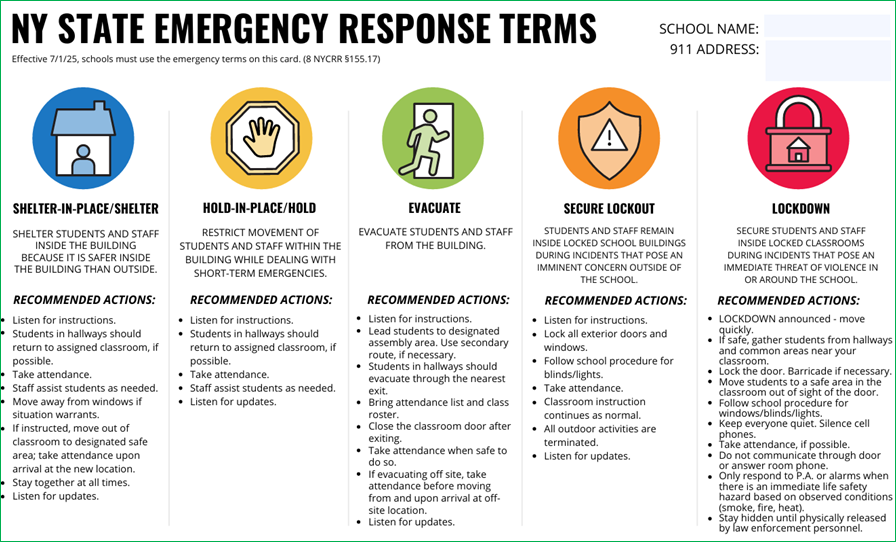
Shelter-in-Place: Shelter-in-Place will be announced by intercom, Public Address (P.A.) System, bullhorn, or otherwise with instructions for how to proceed.
- YOUR ATTENTION PLEASE.
- THERE IS A SITUATION REQUIRING YOU TO SHELTER-IN- PLACE.
- ALL OUTDOOR ACTIVITES ARE CANCELLED.
- PLEASE STOP WHAT YOU ARE DOING AND FOLLOW THESE INSTRUCTIONS.
- Provide specific incident instructions.
When the incident is resolved, Shelter in Place can be released by the Administrator/Incident Commander over the PA or Intercom.
Hold-in-Place: Hold-in-Place will be announced by intercom, Public Address (P.A.) System, bullhorn, or otherwise with instructions for how to proceed.
- YOUR ATTENTION PLEASE.
- HOLD IN PLACE.
- PLEASE RETURN TO CLASSROOMS AND KEEP HALLWAYS CLEAR.
- Provide other specific incident instructions.
Evacuation: Evacuation will be communicated by activating the fire alarm and/or announced by intercom, Public Address (P.A.) System, bullhorn, or otherwise with instructions for how to proceed.
- YOUR ATTENTION PLEASE,
- WE NEED TO EVACUATE THE BUILDING.
- TEACHERS TAKE STUDENTS TO YOUR DESIGNATED ASSEMBLY AREA.
- TEACHERS TAKE YOUR CLASS ROSTER.
- TAKE ATTENDANCE WHEN SAFE TO DO SO.
- DO NOT STOP FOR BELONGINGS.
Designated Evacuation Assembly Areas (On School Grounds)
| Building, Wing or Location | Evacuation Assembly Area |
| P.B. Coeymans School | Primary – West side of building near playgrounds and basketball courts |
Evacuation Location(s) Off School Grounds
If the situation poses a significant enough risk that evacuation of the building and remaining on school grounds is determined to not be adequate, students and staff will be evacuated to an off-site location. The Building-Level Emergency Response Planning Team determines appropriate off-site evacuation areas prior to an actual incident.
Return to Buildings or Grounds
No students or staff shall return to school buildings or grounds until advised to do so by the Incident Commander or appropriate officials.
- The Incident Commander will make the decision when it is safe to return to the building.
- In the event that emergency response services (Police, Fire, EMS) are called, the Incident Commander may transfer incident command to the appropriate authority, who will then make the decision to allow students and staff to return to the building or grounds.
Secure Lockout: Secure Lockout will be announced by intercom, Public Address (P.A.) System, bullhorn, or otherwise with instructions for how to proceed.
- YOUR ATTENTION PLEASE.
- THE SCHOOL IS IN SECURE LOCKOUT.
- ALL OUTDOOR ACTIVITIES ARE CANCELLED.
- If safe, continue regularly scheduled indoor activities.
- Provide incident specific instructions.
When the situation is resolved, Secure Lockout will be released by the Administrator/Incident Commander over the PA or Intercom.
LOCKDOWN provides a time barrier during an incident or emergency LOCKDOWN involves locking classroom doors (barricading if necessary) hiding from view, remaining silent, and readying a plan of evacuation as a last resort.
Actions
Initiate LOCKDOWN: a LOCKDOWN is initiated by:
| LOCKDOWN Alarm System: | |
| Method for LOCKDOWN is Activated: | PA System, manual, can dial into PA from any phone. #99. |
| LOCKDOWN Announcement: | LOCKDOWN, LOCKDOWN, LOCKDOWN. |
| Method for contacting 911: | Anyone with information. |
| Method for locking exterior doors: | Green pull down disables badge access. LE still works. |
| LOCKDOWN system impact on badge access: | Disables |
| Exterior lights or signs to notify individuals outside that the building is in LOCKDOWN: | N/A |
| Procedure for classroom lights: | Leave as is |
| Procedure for classroom blinds: | Leave as is. |
| Procedure for classroom vision panel(s): | Not required. |
| Procedure for accounting for all students, staff, and visitors during LOCKDOWN: | Staff take attendance. |
| Procedure to re-route transportation/buses: | Redirected by Transportation Office. |
| Other LOCKDOWN procedures: | Lockdown in bathroom. Some connected classrooms, LOCKDOWN together. |
| Have key for ERP. |
The announcement is:
- LOCKDOWN! LOCKDOWN! LOCKDOWN!
- Immediately contact 911.
- Notify the District Office.
- IF SAFE, staff should gather students from hallways and common areas into classroom or office.
- Close and lock the door(s), barricade if necessary.
- Move everyone move to the designated safe area of the room.
- Silence cell phones. Remain quiet.
- Take attendance, if possible.
- Only respond to PA or fire alarms if there is an immediate life safety hazard based on observed conditions (smoke, fire, heat).
- Turn lights off and leave blinds as they are.
- Students & staff in hallways or stairwells should immediately get into the nearest classroom.
- If students & staff in bathrooms cannot get into a classroom, they should lock the bathroom door, get inside a stall, stand on toilet.
- Anyone outside the building should seek safety away from the building and should not enter the building. Call 911 and report your location and number of staff/students.
| Starting Location | Rally Point |
| Gazebo side of school | Behind Church rectory |
| Playground side of school | Access road beside school |
- Staff/students who are unable to get into a classroom or office should go to the Rally Point.
- Classroom teachers should position themselves in a location that gives them an advantage to manage their classroom effectively, and take the following action during a LOCKDOWN:
- Do not allow anyone, under any circumstance, to leave your secure area.
- Do not answer or communicate through your door or classroom phone.
- Silence cell phones and limit use to only relay pertinent information to 911, (i.e., description/location of active assailant/victim injuries).
- Do not respond to fire alarm unless actual signs of fire are observed (smoke, fire, heat).
- Document and attend to any injuries to the best of your ability.
- Take attendance and include additions and missing students’ last known location.
- Do not respond to the Public Address (P.A.) system or other announcements.
- If an intruder enters the classroom, use WHATEVER means necessary to protect yourself and the students. You must be prepared to fight for your life and use physical force or possibly deadly force to stop the intruder. Potential tactics include:
- Moving about the room to lessen accuracy.
- Throwing items (books, computers, phones, etc.) to create confusion.
- Assaulting the assailant/intruder – use whatever objects you have in the classroom as a weapon such as blunt force objects (fire extinguishers, chairs, etc.) to incapacitate the intruder – FIGHT!
- Tell students to get out anyway possible – RUN!
LOCKDOWN WILL ONLY END WHEN YOU ARE PHYSICALLY RELEASED FROM YOUR ROOM OR SECURED AREA BY LAW ENFORCEMENT.
In addition to the information above, consider:
- How do we account for all students and staff during an emergency?
- How do we support students and staff who have mobility issues? For evacuation, do we have Areas of Refuge?
- How would we support students and staff who might have difficulty seeing and/or hearing alarms?
- How would we communicate to students and staff who are outside during an emergency?
- Who should I contact with questions about emergency response procedures?
If you have any questions, please contact your building principal.
Slide 30: Incident Command System
Role | Name | Title | ||
| Incident Commander | Directs Incident for school, staff, studentsEstablishes immediate priorities for staff & studentsWorks directly with the Emergency Incident Commander | Primary | Hakim Jones | Principal |
| Alternate | Kelly Doggette | Teacher | ||
| Alternate | Victoria DeGouff | Asst. Principal | ||
| Public Information Officer | Liaison between school and public (including media)Works to coordinate information to be releasedReports to Incident Commander | Primary | Craig Chandler | Superintendent |
| Alternate | Jean Winkler | Assistant Superintendent | ||
| Liaison Officer | Point of contact for school administrators/ staffCoordinates cooperating agenciesReports to Incident Commander | Primary | Christa Lafranier | Guidance |
| Alternate | Deputy Ryan Quay | School Resource Officer | ||
| Safety Officer | Identifies and mitigates hazardous situations for school students & staffMonitors safety conditions and develops measures for assuring safetyReports to the Incident Commander | Primary | Jen Staats | Lead Custodian |
| Alternate | Deputy Ryan Quay | School Resource Officer | ||
Slide 31: Evacuation Drill Procedures
Evacuation Drills:
- Eight of all such drills shall be evacuation drills, four of which shall be through use of fire escapes on buildings where fire escapes are provided or through the use of identified secondary means of egress such as through different corridors, hallways, stairways, and exit doors.
- Evacuation drills shall be conducted with students at least 8 times in each school year, six of which shall be held between September 1 and December 31 or each year.
- Students shall be instructed in the procedure to be followed in the event that a fire occurs during the lunch period or assembly, provided however, that such additional instruction may be waived where a drill is held during the regular school lunch period or assembly.
| How Evacuation Drill is activated in building: | Fire Alarm |
| Method for testing secondary means of egress: | Staff member |
| Method for instructing students about procedures during lunch or assembly: | Staff member stationed |
| Procedures for accounting for all students/staff/visitors during Evacuation Drills: | Take folder. With attendance, Red/Green Cards, CRT member reports to IC/Main Office. |
Slide 32: LOCKDOWN Drill Procedures
LOCKDOWN Drills:
- Four of all such required drills shall be LOCKDOWN Drills.
- Lockdown drills shall be conducted with students at least four times in each school year, two of which shall be held between September 1 and December 31 of each school year.
Notification to Law Enforcement that the school is conducting a LOCKDOWN Drill (yes/no): | Yes |
| LOCKDOWN Drill Announcement: | Yes |
| Method for notifying staff and students outside that a LOCKDOWN Drill is in progress: | PA System, Radio |
| Procedures for accounting for all students/staff/visitors during LOCKDOWN Drills: | Staff take attendance. |
| Procedures for conducting room checks during LOCKDOWN Drills: | SROs check doors line of sight, put in HIP. |
| Procedures for releasing LOCKDOWN Drills: | PA System released drill. |
ADDITIONAL INFORMATION
Effective 9/1/2025, Desha’s Law mandates that school safety plans include a comprehensive cardiac emergency response plan. The plan must outline procedures and designate appropriate personnel to respond to sudden cardiac arrest or similar life-threatening emergencies occurring on school grounds or at school-sponsored events.
Heart attacks and sudden cardiac arrest are two different conditions. A heart attack is a circulation problem that occurs when blood flow to the heart is reduced or blocked. Sudden cardiac arrest is an electrical problem that occurs when the heart suddenly stops beating and the heart can’t pump blood to the brain, lungs and other organs. Cardiac arrest causes a person to lose consciousness and pulse.
Automated external defibrillators (AEDs) are lightweight, portable devices designed to save the lives of people experiencing sudden cardiac arrest in a public setting and can be used on children, teens and adults.
Everyone in the school should know where the AED is located. Trained staff will use the AEDs but you may be called upon to retrieve it during an emergency.
| Location of AEDs: | Cafeteria Hallway |
For more information, please review your school’s AED Program and consult with your principal and nurse.
Please note, this information is subject to change during the school year.
Please routinely verify the accuracy of this information.
If you have any questions, please contact your building principal.
Thank you for your participation!
This information is confidential.
Do not provide this information to anyone.
Do not post this information online or leave it someplace where it could be reviewed and/or accessed.